
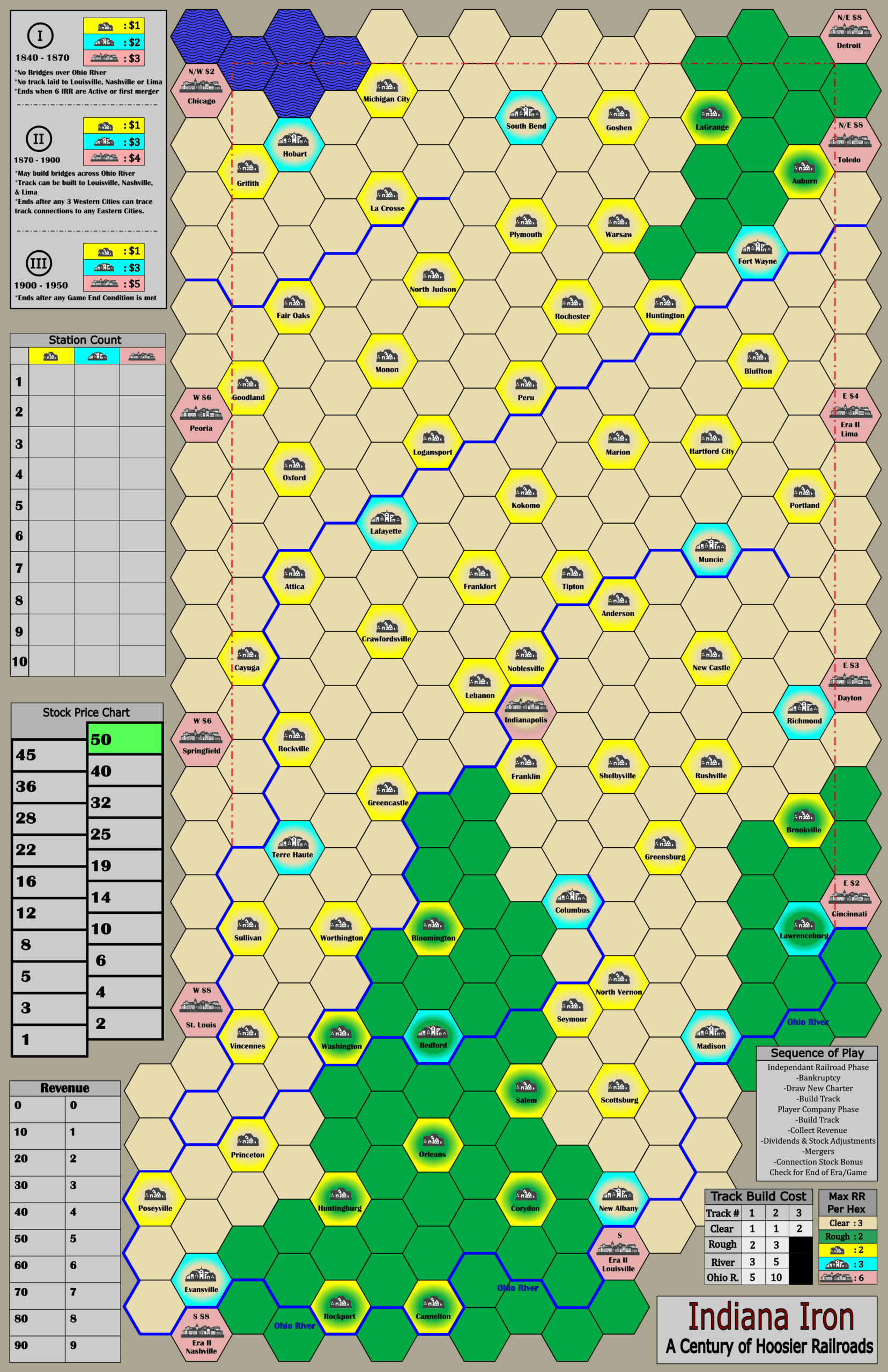
Over the years I’ve sketched designs for dozens of games. Most were either unplayable, boring, or simply too expensive to produce, often all three. It wasn’t until I began experimenting with 3D printing and self‑publishing that I realized some of my ideas actually had market potential.
Flashback to 2021: A post‑COVID world, I was a new dad, traveling constantly for work. With nowhere fun to go, countless late‑night sessions rocking a baby to sleep, and endless hours in airport lounges, I found the quiet time to tinker with ways to bring my game concepts to life. I started with my then current obsession, 18XX train games (1846, 1817, 18Chesapeake, etc.). I’m terrible at them, truly awful, but I love the themes, mechanics, and player interaction that each title offers. I also have a soft spot for the simpler cube‑rails style games.
What drew me to 18XX was the network building and the tension between players. What I don’t love are the interminable stock rounds that can drag on for 45 minutes. My brain just can’t keep up with the byzantine market manipulations and company dumps. Cube rails, on the other hand, shine with their simplicity and speed, yet they lack a deeper layer of operational planning. I wanted something that sat right in the middle, network building with light economics, and fast playing. I searched, but nothing quite fit.
 The spark came when I stumbled upon an 1890s railroad map of Indiana while perusing the Library of Congress website. I thought, “Wouldn’t it be cool if a game could end up looking like this?” My earliest rule drafts were packed with complex merger‑and‑acquisition systems, multi‑railroad revenue calculations, and other intricate bits. My usual method is to throw every idea into the stew pot and see what actually makes the flavor palatable. This analogy is terrible, but close enough to how I work.
The map’s scale was another hurdle. At roughly 4–5 miles per hex, Indiana’s 140‑mile width would need 28–32 hexes—even with tiny hexes, that meant a massive, costly board. Anyone who’s designed, published, or bought a game with a map over 22 inches knows the price climbs fast. Dropping the scale to 12‑mile hexes solved the size problem, though it sacrificed some of the granularity I’d enjoyed in the early drafts.
It was worth it, because one of my other goals was a playtime of 90–120 minutes for 3–5 players. So the basic outline emerged, a railroad themed game for 3–5 players, focused on network building and light economics, designed to fit into a short evening session. Using the Indiana railroad map as my foundation, I began toying with various ideas.
I scrapped the stock‑buying‑and‑selling mechanic outright—it clashed with the time‑limit and light‑economy goals. Instead, each company’s stock price would track throughout the game and become a component of the final score. This shifted the player role from “individual out for personal gain” to “company out for its own best gain.” It’s not a perfect match for 19th‑century American railroad history, but it keeps the bookkeeping minimal.
One concept that survived from the very first draft was the presence of independent railroads. These bot‑run companies act as acquisition targets and roadblocks to expansion. Their charters list historic or planned destinations, and a simple logic determines how they lay track each turn. Player‑owned companies can now grow either by building new track or by snapping up these independents.
Part 2 of the dissection of my railroad design idea should drop in a couple weeks.